Reprinted with permission of LABORPRAXIS
Some watch it more closely possibly due to their corpulence, others not so much – caloric information on food products is a requirement in the European Union. But what does this information really indicate about the “energy value” of food? A holistic view.
Every food label contains the ingredients, the manufacturer’s information and the expiration date along with information on the energy/caloric content. EU regulation no. 1169/2011 as well as the Food Information Regulation previously used the classic calorie unit (cal) and kilocalorie (kcal), but according to the current European regulation, joule (J) and kilojoule (kJ) per unit of weight is now shared as well. But what exactly does this value tell us? Where does the information come from and how is the calorific content precisely determined?
About calories and calorimeters
The word ‘calorie’ is derived from the Latin word calor for ‘heat’. A calorie represents the amount of energy needed to heat 1 g of water by one degree Celsius. So-called combustion calorimeters (see Fig. 1) are used to measure the physical energy content in food.
In this scenario, a sample under pressurized oxygen is completely burnt under controlled conditions. All components of the previously homogenized and prepared food samples are completely oxidized. The organic components are present after combustion in the form of CO2, water and acids in the combustion chamber of the calorimeter.
As shown in Fig. 1, the sample is burned in a combustion chamber (flame) and the released heat is transferred to the surrounding water. The water must be mixed sufficiently enough in order to ensure uniform heat distribution. Using a temperature sensor, the temperature can be determined to a precision level of one ten thousandth of a degree Celsius before and after the test.
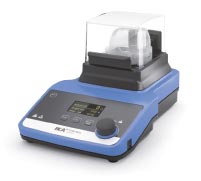
The compact static jacket calorimeter from IKA shown here has an uncontrolled (static) jacket that – as the name suggests – provides an insulating function. All of the work steps related to the calorimeter, such as water and oxygen handling, are completed, entirely automatically, by the device. Since there is always a small flow of heat, it must be pre-determined so that the temperature can then be corrected. This is accomplished by using one of the classic correction calculation methods in calorimeter standards for an isoperibolic calorimeter (Regnault-Pfaundler) (see Fig. 2).
 |
| Fig. 1 – In a so-called energy calorimeter, the sample is burned in a combustion chamber and the released heat is transferred to the surrounding water | Fig. 2 – Classic corrective calculation method of calorimeter standards for an isoperibolic calorimeter (Regnault-Pfaundler). |
Physical energy value
The sample preparation is a decisive part in determining the energy value. Food should generally be placed in the calorimeter already freeze-dried and homogenized. The result is influenced mostly by the water content of the sample. The calorimeter provides the so-called physical energy value.
This means that the sample was fully combusted. In our bodies, however, these processes do not work in the same way as in a combustion calorimeter, but are rather staged in a great number of individual steps during which a comparably tiny amount of energy is released. This energy is used for the synthesis of substances needed by the body and for maintaining the body temperature. Special energy-rich molecules are built up that can be used later and at other points for the biosynthesis of compounds. In other words, one does not need to constantly eat in order to have energy available and to build up materials. This means that the organism never fully breaks down the material it took in; it eliminates a part thereof, primarily a part that it cannot break down, but which can be physically burned. The energy values measured in the calorimeter are thus generally higher than those listed on the food identification label, because these figures describe the value that is actually released from the organism--the so-called physiological energy value.
Energy values
Where do energy values on food labels come from? In the beginning of the 20th century, Wilbur Olin Atwater determined the physical energy content of food using a bomb calorimeter. The main components were described according to the amounts of energy. The applicable physiological energy values were then determined. For proteins, this value was lower than the physical:
| 1 g protein | 4 kcal | = 17 kJ |
| (instead 5 kcal = 22 kJ)d |
| 1 g carbohydrate | 4 kcal | = 17 kJ |
| 1 g fat | 9 kcal | = 39 kJ |
| 1 g alcohol | | |
| (ethanol) | 7 kcal = | 29 kJ |
Physiological energy value
In order for a person to eat food optimally, one prerequisite is first to crush it well, to chew it, to allow the saliva to act, then it can be better digested and the individual components optimally processed by the healthy body. Fats are in some cases stored or, to cover basic energy needs, are accessed directly and converted into energy. However, the preparation of food is important here. Some foods may be poorly digested in its raw state and poorly utilized by the body. In order to know the optimal personal energy value for food, one would first have to determine one’s own basic energy expenditure. There are studies in which people were evaluated specifically in that regard. This includes, among other things, breathing, CO2 output (“combustion efficiency” of the body), at rest and while working.
DETERMINED ENERGY VALUE IN COMPARISON TO THE LABELLED ENERGY VALUES (CHART) |
| | Physiological energy value J/g (Label) | Physical energy value J/g (Calorimeter) | Differences Label – Calorimeter J/g |
| Noodles | 15,010 | 16,238 | - 1,228 |
| Yellow gummi bears | 14,590 | 14,173 | + 417 |
| Sugar | 17,000 | 16,475 | + 525 |
| Zwieback toast | 16,930 | 18,435 | - 1,505 |
| Sugar beet syrup | 12,670 | 12,527 | + 143 |
| Almonds | 24,660 | 29,134 | - 4,474 |
As mentioned, the body does not always break down the substances absorbed with food with the same degree of completeness. This depends on the situation at that moment, but also, of course, on the particular individual. In addition, some physically oxidizable components such as dietary fiber are generally not broken down because humans lack the necessary enzymes. Thus, in order to determine the physiological energy value, the energy content of the food must first be determined in a combustion calorimeter. Then, also the stool and urine need to be examined. The energy in the food minus the energy in the feces and urine is the energy of the food actually released in the body of the person investigated. Such studies are common practice, for example in the field of agriculture and animal feed research.
Here the standard DIN EN ISO 9831 is frequently applied, such as in carrying out nutritional studies [1].
For food labelling, however, an average person is assumed, and this may also be defined differently depending on the country, which exhibits an assumed average metabolism for processing food. In humans, the process of food processing, energy use and usability is still affected by a variety of other factors. As a result, anyone who does not correspond to the average acts based on an incorrect energy value or caloric content.
Listing of caloric contents
 |
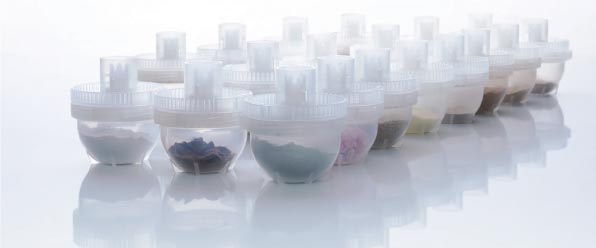
| Fig. 3 – The food samples were ground to a fine powder, contamination- free, in an IKA Tube Mill control. |
Below various foods were evaluated for their physical energy value. The samples were ground to a fine powder, contamination-free, in an IKA Tube Mill control (see Fig. 3). Table 1 shows the measured energy values compared to the specified energy value on the food label.
Since, however, and as already mentioned above, food can be processed very differently from person to person, and depending on how well cooked and chewed the food is, the physiological energy value is not equally applicable to all people. The physical energy value allows for better comparability of the energy in different foods, as this can be determined directly and without detours and adjustments by simple combustion in the calorimeter under pressurized oxygen. Under this precondition, would a physical energy value not be better suited for a general comparison of the energy/caloric content of foods? Where applicable, the energy content of substances that are indigestible by humans could be subtracted from the total value.
Browse the full selection of Calorimeters available at Cole-Parmer
Article from LABORPRAXIS, September issue 2015, page 52–54, www.laborpraxis.de DR. ISENGARD (H.C., H.-D.) Professor at the University of Hohenheim, Institute of Food Science and Biotechnology, 70593 Stuttgart KAI-OLIVER LINDE IKA-Werke GmbH & Co. KG, 79219 Staufen im Breisgau, Tel. +49-7633-831-0


