Using Better Temperature Control to Deliver Better Product Quality To detail the specifics about temperature control, we tapped into experts Jim Cottrell (JC), Global Marketing Manager for Honeywell, and Bob Hoffman (BH), Technical Assistance, Honeywell. 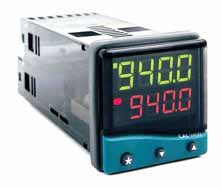 | Temperature and process controllers can offer single-line and dual-line displays and PID autotuning. | | | | Q: What effect does temperature control have in an industrial process application? More specifically, what results have you witnessed when proper temperature control is maintained? JC: Temperature can be key to the process. If your temperature controls are controlling accurately, you conserve energy and produce a more consistent product. In refrigeration, a lower temperature than necessary means more expended energy. The goal is to select a temperature controller that balances the need for efficiency and repeatability. BH: Proper temperature control improves efficiency. Overall, most users’ goals are to maximize their profit and ensure the reliability of their product. To do this, they have to consistently deliver a product that meets their quality standards. Keep in mind, controllers work within certain boundaries of temperature. For example, some controllers work within a range of plus/minus 3 degrees F (1.6 degrees C). Others, such as industrial controllers, can regulate with plus/minus 0.5 degree F (0.27 degree C). For applications that require a higher level of control, as in aviation parts manufacturers, a smaller range is needed. For a paper manufacturer, a wider range may be sufficient. Thus greater efficiency is achieved with tighter temperature control. Q: What happens with poor temperature control? JC: Poor temperature control can result in lost energy, an inconsistent product, and even equipment and safety concerns. Let’s say the heat stays on too long. It can damage the product, the equipment, and even be potentially dangerous. Likewise, if cooling is left on too long, it can not only damage the product but could cause excessive wear on supporting devices. For example, a compressor can be overstressed leading it to overheat, freeze-up, and/or fail. We recommend using two controllers in the process. One is the primary controller regulating the process while the other is the high-limit temperature controller. This second unit shuts off or adjusts the temperature if a threat of overheating or overcooling is present. In terms of production, this dual unit approach keeps the process running and also helps sustain product quality. BH: As Jim indicated, poor temperature control results in excessive wear of the system. Final controls, such as heater elements motors and SCR’s, may wear out much faster than normal. Q: It seems clear that the type of controller you are using makes a significant difference. Compare basic controllers to advanced models. What advancements have developed? JC: The basic models essentially act as an on/off switch, much like the thermostat in your home. Basic controllers work effectively for simple applications where a precise temperature isn’t required. An example of an application that may use a basic controller is the storage of food. 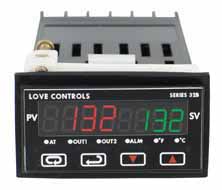 | Temperature and process controls can incorporate dual alarms and a universal controller design that accepts thermocouple, RTD, voltage, and current levels. | | BH: The next level above on/off control is proportional control. Proportional control algorithms adjust the output in proportion to the amount of power needed. For example, on/off control will only position an output at either 0 or 100%. Proportional control, based upon the difference between the input signal, set point, and tuning values, will throttle the controllers until the desired temperature is reached and maintained. Proportional control works best when an exact temperature is required. Advanced controllers use sensors to anticipate variables and make adjustments. The algorithm in advanced controllers measures data—such as temperature, flow, humidity—and uses additional algorithms to correct variances. With a refrigeration unit, the advanced controller may measure the temperature of the cooling fluid as well as the chamber temperature. One type of advanced model is the Cascade Controller. It measures dual variables. In food processing, a cascade control unit may monitor the temperature of food as well as the temperature of the hot water that is cooking. Cascade Control is used in many different applications, especially when a slower process and a faster process are both involved in production. Another advanced level unit is the Feed Forward Controller, which measures the material at different stages in the process. In measuring temperature and flow, the flow is fed forward and any changes from the normal value are reset. For example, mashed potato producers may feed potatoes into their cooker then through the processing line. The potatoes may cool as they move through the process, so the Feed Forward Controller will raise the temperature to heat them back up. Ratio Control is another option in advanced temperature controllers. As its name implies, it adjusts the variables according to the desired ratio. When placing fuel and air into a combustion chamber, there is a combination of both materials that creates the ideal combustion. The ratio controller maintains this ideal level. All of the advanced temperature controllers require the input of calculations to maintain the variables they are measuring. Q: Any other functionality that is beneficial in maintaining temperature? JC: All of the instruments need to be tuned (or adjusted) to the process. Many controllers are adjusted manually by changing the temperature and assessing how the process responds. More advanced controllers offer features such as autotune (also referred to as adaptive tune or smart tune, etc.) that can automatically tune the controller to the process dynamics. This feature can save time and make the start-up process quick and easy. Newer features include the ability to network the temperature controller or connect it to the Internet. This allows users to monitor the process from a remote location. This feature also has the capability of sending you an e-mail to alert you of a change in temperature, functioning as a process alarm. Some controllers are available with predictive features that can determine if thermocouple sensors are going to fail. Using unique algorithms, they can monitor the thermocouple junction and predict a failure before it shuts down the process. By issuing an alarm, the thermocouple can be replaced before it fails saving valuable production time. Q: Are temperature controllers sometimes integrated into a process? JC: Several manufacturers provide controllers that can be integrated as part of the overall electronics as opposed to stand-alone units. These controllers are typically provided as a circuit board and imbedded into the process. BH: In pharmaceutical manufacturing, which requires a higher level of control, you may see many temperature loops tied into one system. This regulates the temperature of many different lines of products. Q: What are the limitations of temperature controllers? JC: Sometimes there is confusion between the temperature controller and the process itself. While temperature controllers are available with a wide variety of options and must be selected carefully, they cannot compensate for other shortcomings in the process. For example, if a heater is not properly sized and doesn’t have the capacity to meet the demand for heat, upgrading the controller will not solve the problem. BH: First, the user needs to understand the process. You have to look at your inputs and outputs. Have you chosen a temperature controller that offers the accuracy and precision you need? With the move from analog displays to digital, digital instrumentation can provide much more precision. 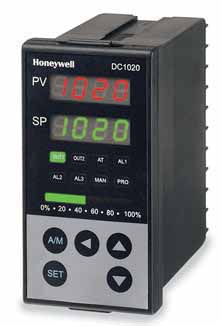 | Microprocessor-based controllers can combine a high degree of functionality
and reliability. | | | | Q: When choosing a temperature controller, what criteria should I consider? JC: Of course, it will depend on the user’s application. Repeatability and quality are key considerations. Accuracy is another. In some applications, temperature accuracy is critical. For example, with a laboratory developing a product, one degree of difference in temperature may denote the difference between success and failure. The physical location of the product is also a consideration—indoors or outdoors. Some controllers are not manufactured for outdoor use and lack the ruggedness necessary. Selecting a watertight controller for food and beverage applications is best because the equipment is regularly washed down. BH: I agree that you need to assess the application. Find out what your variables are, then decide what type of algorithms are needed for the process. Some of the questions that need to be asked include: Do you need advanced control algorithms? How many inputs? As discussed earlier, how many variables will be measured? Do you need a precise set point or is a temperature range sufficient for your use? These choices within functionality will determine how effective your temperature controller is for your process and, ultimately, how it can work seamlessly to create the best product possible. | 


