RoHS And WEEE - Essential Aspects
Introduction - What are RoHS and WEEE?
The full names of these important European Union directives are:
RoHS: Directive 2002/95 / EC of the European Parliament and of the Council of 27 January 2003 on the restrição the use of certain substances nocivas in electrical equipment - This Directive restricts the use of hazardous substances (lead, mercury, cadmium , hexavalent chromium, PPB and PBDE) in electro-electronic equipment at the manufacturing and production stage. The RoHS Directive means that products containing the restricted substances will have to be redesigned or removed in July 2006.
WEEE: Directive 2002/96 / EC of the European Parliament and of the Council of 27 January 2003 on waste electrical and electronic equipment (Equipment Disposal Electro-This Directive covers the treatment and recycling of electrical and electronic equipment The WEEE Directive requires manufacturers to pay at least for the collection of their products at the end of their duration, establishing central points and meeting the goals of the WEEE, to ensure that the WEEE is re-used and recycled, and to reduce the amount of WEEE being discarded. reuse, recycling and recovery.
The disposal of electro-electronic equipment is the fastest growing municipal waste source in Europe. The two guidelines, initially released as a single combined guideline, aimed at reducing the environmental impact of WEEE. It was then noted that it was necessary to address both the beginning and the end of the product life cycle to deal adequately with the issue.
This is best illustrated by the trash hierarchy shown below.

Reducing the environmental impact of a product begins at the design and manufacturing stage. Eliminating or reducing the use of toxic substances is the most effective measure if substances are removed at source and are not present, so there is no need for special treatment of the waste. RoHS addresses aspects of disposal and reduction of the waste hierarchy.
If harmful substances have been used, it is best to reuse or recycle the waste to reduce the environmental impact. Only when these measures have been performed will the appropriate disposal of the waste be acceptable. WEEE deals with the reuse, recycling, and disposal of the waste hierarchy.
Much of the initiatives and advertising around RoHS and WEEE to date focus on the heavy metals in circuits and the problem facing the electronics industry, but if the product is not exempt, then the Guidelines cover all materials in the WEEE including plastic materials. Some substances included in the RoHS list have been or are extensively used in plastics (eg lead-based stabilizers, where the predominant method of stabilization in PVC, cadmium-based dyes are widely used in the production of red pigments for many types of plastics , and PBB and PBDE are used as flame retardants). Plastics producers can not ignore the RoHS and WEEE guidelines and find that they will go unpunished.
Definitions and Scope
The RoHS and WEEE guidelines share many common definitions and these are important in deciding whether the Guidelines encompass suppliers and products. The relevant definitions are:
- 'Electrical and electronic equipment' means any equipment which depends on electrical currents or magnetic fields in order to function properly, equipment for the generation, transfer and measurement of such currents and fields and equipment designed for use with a rated voltage of up to 1000 volts for current alternating current and 1500 volts for direct current.
- 'Producer' means any person who, irrespective of the sales technique employed:
• Manufactures and sells its own brand of electrical and electronic equipment.
• Resell equipment produced by other suppliers under its brand.
• Import or export electrical and electronic equipment in a participating State. - 'Distributor' means any person who provides commercially available consumer electronic equipment to third parties for use.
- The product areas covered by RoHS and WEEE are practically the same and are listed in the table below:
| Product Category | RoHS: | WEEE: |
| Large Appliances | YEA | YEA |
| Small Appliances | YEA | YEA |
| IT and telecommunications equipment | YEA | YEA |
| Consumer Equipment | YEA | YEA |
| Lighting equipment | YEA | YEA |
| Electrical and electronic tools (except for large-scale static industrial tools) | YEA | YEA |
| Toys, sports and leisure equipment | YEA | YEA |
| Medical devices (with the exception of all implanted and infected products) | NOT | YEA |
| Monitoring and control instruments | NOT | YEA |
| Automatic applicators | YEA | YEA |
| Lamps | YEA | NOT |
| Fixtures | YEA | NOT |
This list should be considered provisional, see the 'Exceptions' section (below). For more details on product examples included in each product category, see Annex II of the WEEE Guideline.
RoHS in Detail
The substances affected
To meet RoHS, as of July 2006, manufacturers will have to demonstrate that their products contain no more than the maximum permitted levels of:
- Lead (Pb)
- Mercury (Hg)
- Cadmium (Cd)
- Hexavalent Chromium (Cr VI)
- Polybrominated Biphenyls (PBB)
- Polybrominated diphenyl ethers (PBDEs)
The proposed maximum permissible levels should be 0.01% by weight for cadmium in any single homogeneous material and 0.1% of other substances. At first there was much debate as to what would be a homogeneous material and whether this referred to a component or set. This needs to be clarified and a homogeneous material is now known with a single substance such as plastic. For example, the plastic used in the insulation of a wire is considered with a simple substance. The wire insulation assembly is not considered as a simple substance, but rather a component. A component may contain several different materials that should be considered individually.
The Exceptions
There are some exceptions for products and applications listed in the RoHS Directive, but these are primarily concerned with the use of materials in non-plastic applications and are not considered in this Bulletin. A complete list of current exceptions is given in the Annex to the RoHS Directive.
Additional exemptions of products and applications have been applied, such as for bulbs, and are currently being evaluated by the EU. It is unlikely that all the exceptions applied will be granted, but the vast majority do not affect the application of plastics in the WEEE.
Where are the most commonly used affected substances in plastics?
In most cases, the affected materials have already been phased out for processing plastics due to increasing environmental pressures. Some examples of previous uses are:
- Lead - Lead - based stabilizers have been used in PVC for various purposes in the past, but such practices have been replaced by the use of other stabilizing systems, for example Ba / Ca / Sn systems.
- Cadmium - Cadmium has been used as a red dye in plastics in the past, but has been replaced by alternative coloring systems.
- Hexavalent Chromium - It is used in the metallization of plastics and has been rapidly replaced by alternative processes that are less harmful to the environment.
- PBB and PBDE - Widely used as flame retardants in various types of plastics, however, it has already started to be replaced by other flame retardants.
Despite progress, users of plastics in products that are covered by the RoHS and WEEE Guidelines are still directed to seek information from manufacturers of plastic raw materials that the affected substances are not used or are used in quantities below the maximum allowable levels.
Proof of Compliance and Supervision
Proof of compliance may require a producer to 'self-declare' compliance. Such implementation will be supported in the medium and long term by the development of non-mandatory standards for compliance testing and non-mandatory standards in supply chain reporting formats. It is also proposed to create a network for the exchange of information between the competent bodies of the Member States to support this system and to preserve the Europe-wide harmonized approach necessary for the exclusive market base of the Guidelines.
There is currently no detailed guidance (May 2005) on how producers can meet the RoHS guideline, and above all, there is no universal procedure for producers to establish compliance due to the variety of products affected. The most likely current approach is that of "self-declaration". It is assumed that the electrical and electronic equipment available in the market comply with the RoHS Directive.
The simplest solution for producers is developed in two stages:
- Obtain a guarantee from all suppliers that no banned substance is present (except where exempted from such requirements) and keep a permanent record of this guarantee to demonstrate that "reasonable" measures have been taken to comply with the Guideline.
- Conduct a limited product review to verify vendor statements or to provide assurances that supplier statements are available or not. Where there may be a high probability that a product or component contains one of the banned substances (eg PVC or colored red / orange products) analysis may be performed more frequently.
Manufacturer Interests
If the supply chain is complete, producers should then consider the product in the supply chain and identify it appropriately to differentiate between existing non-compatible products and new compatible products, so the supply chain is not completely discarded until the date of implementation required. There will be an obvious need for traceability and product identification to distinguish between compatible and non-compatible products. Producers need to immediately begin to identify compatible products to initiate disposal in the supply chain.
WEEE in detail
The WEEE guideline covers the design and production of electrical and electronic equipment to assist in the recycling of redundant electrical equipment, and transfers the responsibility of recycling to the producer. It will probably require the introduction of a recycling rate as part of the price of new equipment.
The Requirements for Member States
The requirements to the member states are given below:
- Member States shall define systems for the purpose of selective WEEE collection and systems that allow the free return of the WEEE.
- Member States shall obtain a WEEE collection rate of at least 4 kilograms per inhabitant per year (on average) of WEEE from dwellings.
- Member States shall ensure that all WEEE collected from households is transported to authorized treatment facilities.
- Member States should encourage producers to adopt systems for the recovery, reuse and recycling of WEEE according to defined targets, which are a proportion of WEEE collected from households.
- Member states should regularly report their WEEE goals.
There is no obligation for individuals to separate WEEE at source, but participating states should encourage the habit of recovery, reuse and recycling.
Suppliers must ensure that WEEE is returned (regularly) when a new equivalent product is sold, but Member States may allow suppliers to develop other methods, provided they are free of charge to consumers.
The Producer Requirements
The requirements for manufacturers of consumer electronics are as follows:
- From August 2005, manufacturers wishing to market electrical and electronic equipment in any Member State of the European Union will have to ensure that future costs for collecting WEEE from central collection points and other treatment and recycling costs will be met, even in the event of transfer of the business activities of enterprises. This can be achieved by several methods, such as:
• Participate in a financing scheme for WEEE.
• Adopting 'recycling insurance'.
• Opening of bank account for deposits of securities, released only for the payment of WEEE treatment. - Producers selling to commercial customers must provide systems for the collection, treatment and recycling of old products (for the sale of new products), and commercial sales must have the appropriate contractual arrangements for the recovery and recycling of WEEE.
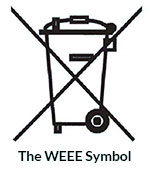
- New products introduced into the markets must be clearly marked with the manufacturer's name and the WEEE symbol (shown on the right) to indicate that it should not be disposed of in municipal waste collection.
- Manufacturers will be required to report on the components and materials used in their products for treatment facilities and the like to have such data for disassembly, reuse and recycling.
- Manufacturers should inform treatment units how to identify specific components and materials in the equipment to be removed, including:
 • Polychlorinated biphenyls containing capacitors.
• Components containing mercury (for example, switches, backlights).
• Battries.
• Printed circuit boards on mobile phones and greater than 10 cm2
• Brominated flame retardants.
• Cathode ray tubes (the fluorescent coating must be removed).
• Gas discharge lamps (the mercury must be removed).
• Monitors of liquid crystal. - Manufacturers will have a joint responsibility for financing the collection and treatment of waste products placed on the market before August 2005 (historical waste). The manufacturer's share of this cost will be calculated according to its market share at the time the equipment is disposed of, but the exact method of financing historical waste has not yet been fully defined.
The World History
RoHS and WEEE are the most important EU Directives and will affect everyone who supplies products directly to any EU member state or who supplies materials or components that may be destined for the EU. Nevertheless, they should not be taken as an exclusively European issue. Similar legislations for WEEE and RoHS are being worked out or considered worldwide, for example, in countries such as China, Japan, Malaysia, Thailand, and the state of California.
The Legislation of the European Union
As in all EU legislation, this first passes the WEEE and RoSH guidelines and EU Member States should then apply them in national legislation to implement the guidelines. The official final date for enactment of national legislation was August 13, 2004, and as of May 2005, 16 member states applied the legislation. They were: Austria, Belgium, Cyprus, Czech Republic, Estonia, Finland, Greece, Hungary, Latvia, Lithuania, Luxembourg, Holland, Portugal, Slovakia, Slovenia and Spain. The remaining 9 member states should enact legislation in the near future, but large EU countries will not meet the official date; there is no provision for implementation in national legislation until January 2006 for countries such as the United Kingdom and Germany.
The delays with respect to the enactment of national legislation refer only to the obligation of producers to receive redundant equipment. In all member states, the obligation to mark equipment for recycling is still scheduled for August 13.
Fluorocarbons

Luckily, fluorocarbon plastics do not use any of the substances determined by RoHS. Consumers can buy extrusions in a natural, non-pigmented state, as these products generally do not contain any of the banned heavy metals.


 • Polychlorinated biphenyls containing capacitors.