Compact Power Supplies
Bring Local DC Power to Control Panels Reprinted with permission from Omron Power Supply
 Most of todays high-speed, high-performance sensors and controllers require a reliable local DC power source. The most cost-effective way to provide that is to use a switching power supply. Essentially, switching power supplies take AC voltage from the power main and convert it to DC voltage with the power rating required by the application. Many switching power supplies are available in compact sizes, ready to mount on DIN rail track in a control panel. Most of todays high-speed, high-performance sensors and controllers require a reliable local DC power source. The most cost-effective way to provide that is to use a switching power supply. Essentially, switching power supplies take AC voltage from the power main and convert it to DC voltage with the power rating required by the application. Many switching power supplies are available in compact sizes, ready to mount on DIN rail track in a control panel. Back to Basics: Linear vs. Switching Power Supplies
There are two categories of power supplies commonly used in industry:
Linear Power Supply: Converts an unregulated DC voltage to a lower regulated voltage by "throwing away" the difference between the two voltages in the form of Heat, which makes it inefficient. Additionally, heat shortens the life of other components in the panel.
Switching Power Supply: Converts an unregulated DC voltage to a lower regulated voltage by storing the difference in a magnetic field, like a "bank account". These footprint of these power supplies is very small compared to Linears, resulting in a smaller panel, space for more components, and overall, a more cost-effective solution.
While both technologies are still important, switching power supplies dominate the AC-DC power conversion choice for most electronic systems sold today, from PLCs 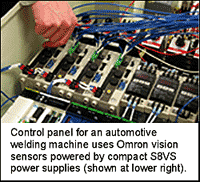 to desktop PCs. The small size, lightweight and high efficiency of switching power supplies give them significant advantages over the linear technology products: to desktop PCs. The small size, lightweight and high efficiency of switching power supplies give them significant advantages over the linear technology products:
- Linears are about 50% efficient while switching power supplies are typically over 80% efficient.
- Switching power supplies are light enough to mount on a DIN rail, while only the smallest linears are capable of being securely mounted to a DIN rail.
- Many switching power supplies meet UL 508 Listing requirements for use at full rating; linears generally do not meet UL 508 because of excessive heat dissipation from their low efficiency.
Powering Todays Machine Controls
Whether you build or maintain control panels for equipment used in food and beverage, automotive, electronic assembly, security, pharmaceutical or other automation equipment, chances are good use switching power supplies. Most of todays machine controls require DC voltage:
- Sensors (photoelectric, proximity, pressure) - Typically require 12-24 VDC
- PLCs - Some types require 24 VDC
- I/O Blocks - All require 24 VDC
- Operator Interface Terminals/Touch Screens - All require 24 VDC
- Bar Code Readers - Require 5 VDC or 24 VDC
- Vision Systems - Some types require 12 or 24 VDC
- Other Automation Equipment that requires a DC supply voltage of 5 V, 12 V, 15 V or 24 V.
Typical Features
Depending on the power rating and requirements of the application, some of the following features have become standard.
Power Factor Correction (PFC): This feature limits the harmonic current on the input side of the power supply, making the input current "cleaner," which in turn, reduces the peak current demand.
Overload protection: Protects power supply from damage caused by abnormal rise in output current.
Overvoltage protection (OVP): Protects load circuit damage by cutting power supply output when output voltage rises above 120% of rated value. For example, if the power supply feedback loop failed, the output voltages would increase to catastrophic levels. The OVP detects an abnormally high voltage, shorts an output, and causes the supply to foldback or shutdown.
Undervoltage Detection Indicator/Output: If the output voltage drops to certain level (75% to 90% of the rated output), a red indicator is illuminated (DC LOW). There is an associated relay output that will also be triggered; this output may be used as an input to a device to initiate shutdown or bypass procedures.
Remote Sensing Function: This function compensates for the voltage drop in the load wiring. Remote sensing forces the supply to regulate a constant voltage at the load, rather than the supply terminals. This is a useful feature with loads above 30 amps.
Remote control function: This function allows the output voltage to be turned "on" and "off" with an external signal (as long as the input voltage is applied).
Product Trends: Adding Helpful Capabilities for Maintenance and Support
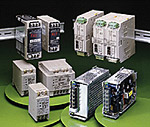 Until a few years ago, switching power supplies offered pretty plain features: single models to match specific AC-to-DC power conversion needs. Now they can help with predictive maintenance and offer easy-to-configure custom power needs. Heres whats new: Until a few years ago, switching power supplies offered pretty plain features: single models to match specific AC-to-DC power conversion needs. Now they can help with predictive maintenance and offer easy-to-configure custom power needs. Heres whats new:
Todays models offer built-in tools to prevent downtime by predicting failure of a panels power supply. Omron introduced the industrys first compact power supplies that turn on a signal output to a controller based on estimated remaining service life or the number of hours a connected load has been operating.
For new designs and retrofits, now you can build a mixed voltage or custom wattage power supply from track-mount blocks and connectors to meet your exact needs. This meets users needs to reduce the inventory of stocked parts to support the power supplies installed throughout a whole plant.
DC Power Supply Selection Process
1. Collect information about your application.
Input voltage and frequency?
Output voltage?
Wattage or power (in amperes) needed?
Don't forget to take into account the peak loading (inrush) of the output.
2) Calculate the power (wattage) of the DC power supply you need. If more than one output is required, do the following calculation:
Multiply the Voltage times the Amperage of each output to calculate the Wattage of each output. Next, add together the Wattage of each output to get the Total Wattage for the supply.
3) Check the enclosure style, connections and physical size of the power supply to ensure it is suitable for the intended application.
4) Check for applicable safety approvals for the country and application the power supply will be used in.
5) What special capabilities or requirements are needed to perform in the application? This can include monitoring length of load ON periods, power supply life, custom power ratings or mixed voltages.
Selection Worksheet
Input: _________ Volts _________ Hz
Output:
_______ VDC x _______ A = _______Watts
_______ VDC x _______ A = _______Watts
_______ VDC x _______ A = _______Watts
_______ VDC x _______ A = _______Watts
Add Watts from each output to calculate Total Wattage.
Physical Dimensions:
_______ H x _______ W x _______D
Other required features or options:
| |


 Most of todays high-speed, high-performance sensors and controllers require a reliable local DC power source. The most cost-effective way to provide that is to use a switching power supply. Essentially, switching power supplies take AC voltage from the power main and convert it to DC voltage with the power rating required by the application. Many switching power supplies are available in compact sizes, ready to mount on DIN rail track in a control panel.
  to desktop PCs. The small size, lightweight and high efficiency of switching power supplies give them significant advantages over the linear technology products:

 Until a few years ago, switching power supplies offered pretty plain features: single models to match specific AC-to-DC power conversion needs. Now they can help with predictive maintenance and offer easy-to-configure custom power needs. Heres whats new: