GLP Compliance in Field Research By Bhaskar Narayanan and S. Raghuraman The Principles of GLP (Good Laboratory Practice) represent an internationally recognised benchmark of test methods and processes for non-clinical health and environmental safety studies. It provides a uniform standard upon which researches are carried out and forms the basis for mutual acceptance of research data between countries. To researchers and government agencies for environmental control, being GLP-compliant is important in lending recognition to the integrity of their research, as well as ensuring a smooth audit process. This said, managing the quality of a GLP-compliant research without the support of laboratory facilities can be a tricky affair, especially in settings where several factors are beyond the researcher’s influence. Since data collected from field research essentially forms the fundamental to research work—and that means that results collected from the field ought to be as accurate as possible—the process of field data acquisition must be carefully managed, among external elements outside the control of a researcher, to ensure GLP compliance. Because of this, in the context of studies involving surface water analysis, the meters used during fieldwork are not only important in providing accurate results, but also instrumental in helping to ensure compliance during data-acquisition. In particular, the OECD’s published Consensus Document, “The Application of the GLP Principles to Field Studies” (OECD, 1999) underscore the need to place special emphasis on two major aspects of fieldwork—Equipment and Data Recording in the field: 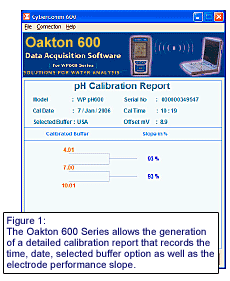 Equipment Equipment The apparatus employed should be of appropriate design and adequate capacity. For instruments used in outdoors water analysis, this translates into a need to measure accurately at a required range and resolution. Housing of the equipment should also be sufficiently rugged, and waterproof to survive the outdoors elements. At the same time, sophistication of the apparatus should be balanced with ease-of-use so as not to hinder the test processes. To ensure accuracy, all research instruments must be cleaned, checked, maintained and calibrated periodically, with calibration benchmarked against national or international standards of measurements. The GLP Principles require researchers to keep records of each maintenance and calibration session for auditing purposes. For instance, a calibration-due alarm in the Oakton 600 series alerts on a scheduled calibration date. Late calibrations are reflected in the meter, and all calibration details can be generated into a report and saved as an in-editable file in the computer using the supplied Data Acquisition Software (see Figure 1). Data Recording The GLP Principles require raw data generated during the field research to be documented legibly, directly and promptly. Using the auto-logging function in a meter can facilitate immediate and accurate data-entry without the risk of accidental data-loss or human error that may occur with recording on paper. For full traceability, recorded data must be stamped with time and date of measure. A common problem with field-research is the amount of storage facilities available for recording data. Instruments intended to measure and record should have enough temporary storage memory for sufficient samplings to ensure integrity of the research. Until the raw data can be transferred for analysis and archiving, the data should be secured from accidental deletion or editing. For this, password protection and volatile memory function on the meter is important to ensure that the acquired data is well-preserved, even when the equipment is out of batteries. Finally, in the case of where data is transferred to and generated using a computer programme, the designed programme used must ensure identification of the individual responsible for data-entry. Figure 2 and 3 illustrate how the data acquisition software accompanying the Oakton 600 series prompt for identification person responsible for the entry. The data, which is directly and wirelessly transferred to the computer, is presented in the form of an in-editable report. Researchers can transfer the information out onto another programme for further analysis. Any changes to the raw data should not obscure the original figures, and should be fully justified for by means of documentation in the “Note” section. 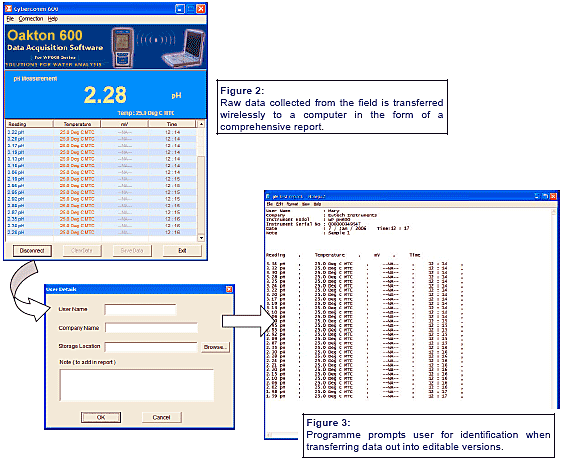 Unlike the laboratory setting, the nature of fieldwork makes it more difficult to implement GLP Principles in the research process. While a field researcher cannot do more to control the weather, technology has made it possible to obtain better equipment support. By choosing the right instruments, complying with GLP can be effortless, even when conducting researches in the field with external factors, without the infrastructure of a laboratory. Measure Smart with the Oakton 600 Series ’s Oakton 600 Series—a new line of waterproof, intuitive handheld meters designed especially for rugged, outdoor applications, yet versatile and powerful enough to be used in the laboratories. Incorporating unparalleled functionality such as compensation of temperature, salinity and barometric pressure, adjustable cell constant settings, high resolution and wide measurement ranges, the meters are engineered to help you achieve unprecedented, lab-accurate results effortlessly, ensuring high quality GLP-compliant research. Presently available for high-quality measurements of the following parameters: pH, conductivity and dissolved oxygen. To find out more about smart measuring, visit our website at http://www.eutechinst,com, or simply email us at [email protected]. Sources:
“OCED Series on Principles of Good Laboratory Practice and Compliance Monitoring: OECD Principles on Good Laboratory Practice”, OECD, 1997
“OECD Series on Principles of GLP and Compliance Monitoring Number 6 (Consensus Document): The Application of the GLP Principles to Field Studies”, OECD, 1999
|


 Equipment